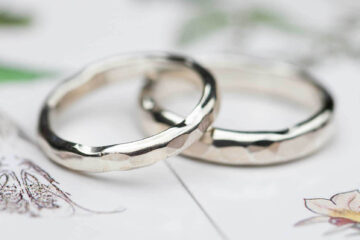
Wedding couples can now head to the Kent countryside to make their own wedding rings

Want to make everlasting memories as well as making your very own wedding rings? Even with no previous experience you can make beautiful wedding rings in Shoreham under the expert guidance of Elizabeth Anne Norris.

Take some time out from wedding planning in a rural setting, just a short hop from the city.

Spend a fun-filled afternoon on a picturesque Victorian Dairy Farm creating your own wedding rings together.

Do something completely different to walking into a shop and buying generic wedding rings.

Create unique wedding rings as well as lasting memories that you can treasure forever.

Enjoy this unique experience in Kent and make your own special rings.

With English Wedding member Elizabeth Anne Norris Jewellery.

Laura and Matthew said in October 2023 “We had the most amazing afternoon making our wedding rings together with Elizabeth. We felt so at ease and welcome, and the instruction and assistance she provides when you are making your rings is exceptional. She even got us our favourite biscuits to snack on while we worked. We are over the moon with our rings and would recommend to anyone considering making your own.”

In this half day workshop you will:

1. Be guided step by step to make your wedding rings according to your designs (discussed and decided prior to your arrival)
2. Be supported by expert jeweller and teacher Elizabeth who can check your progress at every stage and rest assured she can fix any mistakes (doubtful she’ll let that happen though!)
3. Learn traditional jewellery making techniques in a fun relaxed atmosphere.
4. Spend quality time with your partner, having fun and making wonderful memories as part of your wedding planning process.
5. Take away your bespoke rings that you made at the end of the day.
6. Celebrate with your goodie bag containing champagne, handmade chocolates and discount vouchers.

Included in this workshop is a:

* 30 minute telephone consultation about your rings
* 4 hour workshop
* Celebratory goodie bag including champagne & chocolates
* Step by step tuition showing you how to create your wedding rings to your design
* One ring resizing within 12 months of your workshop (if necessary)
* £430 + cost of materials

A few words from Elizabeth:

“I have been designing handmade jewellery since 1999 and have made over 1000 rings. More recently, I’ve helped 100s of couples create their own wedding rings. It is my absolute pleasure to offer you this special experience to get hands on and make your wedding rings”.

As an introductory time limited offer, enjoy £50 off selected wedding ring workshop dates. For this and more information head to www.eanjewellery.com


While we love a simple, contemporary engagement ring, there’s nothing quite like a vintage inspired sparkler to evoke the true romantic in all of us! If you love all things antique and are looking for something a little bit different, here’s our simple guide to some of the different eras.


While rings in many guises have been exchanged between couples as a sign of engagement and betrothal for centuries, many jewellery designers refer back to various design trends from the last 150 years. And each era has its own distinctive features that reflect the popular styles of the day. From traditional, classic engagement rings, to more ornate pieces – these enduring styles conjure up images of elegant, romantic times. There’s just something so magical about these vintage designs!

Georgian & Regency, 1714-1830, Kings George I, II, III and IV
Diamonds, pearls, rubies, garnets and sapphires were the favourite stones of the Georgians and when it comes to metals, they preferred silver to gold. We often associate symmetrical architecture with the Georgians and this is also reflected in their jewellery. They were heavily inspired by nature and often incorporated intricate shapes and interesting gemstone cuts. They are famed for inventing the ‘halo’ style – where smaller stones frame a larger gem – and this is still one of the best-selling engagement ring styles.

Victorian 1837-1901, Queen Victoria
Victorian jewellery went through three notable periods – romantic, grand and aesthetic. Modern Victorians also loved nature and this inspired them to create intricate floral and leaf designs out of metalwork. When it comes to gems, they incorporated pearls, ivory, tortoiseshell, coral, onyx, amber and quartz – alongside the more traditional diamonds and other precious stones. The styles were heavily symbolic and romantic, with rose cut, old mine cut and marquise cut stones. The era is also known for meaningful mourning jewellery, where an item of jewellery is worn in memory of a lost loved one, with some including a lock of hair or a personalised motto.

Edwardian 1901-1910, King Edward VII
Europe refers to this era as ‘La Belle Epoque’– the beautiful era – and this is reflected in the jewellery of the day. The upper classes, including the King, had a huge influence on the styles and showing off their luxury and wealth. Jewellery became more elaborate and showy as they embraced new techniques for jewellery making larger, lavish pieces influenced by the Arts & Crafts movement. They embraced floral designs with loved ornate delicate details and intricate lace-like filigree. They used a lot of silver and white, with platinum, silver, pearls and diamonds. Pearls were a real status symbol of the day and we’re used to create light, ethereal styles.

Art-Deco, 1919-1939, George V
The art-deco movement came in with a bang off the back of the austerity of WWI. The distinctive style, covering the 1920s and 30s, features geometric patterns and abstract designs, often created from white gold and platinum. Art-deco styles travelled around the world with fabulous architecture and fashion – with engagement rings often feature bold patterns made from straight lines, triangles, pyramids and arcs with contrasting coloured gems. These flamboyant designs are so stunning they remain a firm favourite for engagement rings today.

Modern Vintage
When it comes to choosing your dream engagement ring, we believe you should always go with your heart and pick a style you love above all others – don’t go for trends. Vintage styles have proved again and again that they stand-the-test-of-time, so our advice is to avoid anything that’s too fashionable. Our dedicated Heritage and Vintage engagement rings and collections are bursting with stunning antique inspired rings – where you’ll find a ring that will never go out of style!

Buying your engagement ring is one of the most exciting purchases of your life, but some of the technical descriptions can be a bit confusing – unless you’re a jeweller! While some are obvious, others are harder to work out so, Emmeline Smith from Infinity Diamond Jewellery shares her quick guide to help get you up to speed with the basics.

The main parts of a ring

Shank or band – is simply the part of the ring that wraps around your finger, in any metal and is the part that will bear any hallmark.

Side stones – also referred to as ‘accent stones’ and are usually smaller gems set either side of the centre stone. They can be the same or different type of gem, in any cut or size to complement and draw attention to the main stone and add a bit of extra dazzle!

Centre stone – is quite self explanatory! It’s the main and usually the biggest stone in the ring.

Head – situated at the top of the ring, the head holds the centre stone in place. There are various different styles and the one you pick will make a big difference to the appearance of the ring.

Engagement Rings

Prongs – also referred to as ‘claws’, these are situated on the head of the ring and are the thin metal strips that hold the gem in place. The amount of prongs varies are usually 4 or 6 and the ends are slightly bent inwards to securely hold the stone.

Shoulders – these are the top two sides of the band, just below the stones. Some shoulders change width as they near the stone setting. They can be super simple or intricate, adorned in stones.

Engagement Rings

Other useful terms

Mount or setting – The setting or mounting refers to how the gems are set onto the metal band.

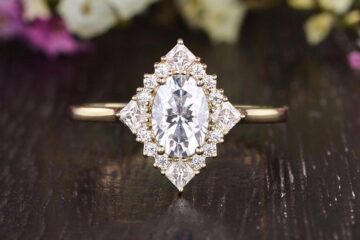
Oval cut, art nouveau style lab-diamond engagement ring – prong setting

Split shank – is when the shank of the ring divides at the shoulders as it approaches the centre stone. The split leaves a visible gap and can give the illusion that the centre stone is bigger than it is. 

Asscher cut, moissanite engagement ring, with split shank

Asscher cut, moissanite engagement ring, with split shank

Bezel – in a full bezel setting, the centre stone is set within a thin metal rim, which completely surrounds the stone, holding it in place. A partial-bezel setting covers just two sides of the stone.

Oval cut, three stone moissanite bezel engagement ring

Oval cut, three stone moissanite bezel engagement ring

Pavé (or micro-pavé) – this is French word for paved and means the surface of jewellery is literally paved with a series of small gems set close together, totally covering the metal below. This ensures the optimum opportunity for sparkle, ensuring every surface glimmers.

Round cut, moissanite engagement ring with Pavé band

Round cut, moissanite engagement ring with Pavé band

Halo – is a ring, or border of smaller stones around the outside of the main stone, forming a ‘halo’. Not only are they super sparkly, but if it’s the same colour as the main stone, it gives the illusion of it being bigger, while if it’s a different colour, it draws the eye to the centre stone – a stunning and timeless feature.

Round cut, moissanite engagement ring with halo

Round cut, moissanite engagement ring with halo // Lab-grown ruby engagement ring with halo

Hidden halo – similar to above, a hidden halo’s a frame of smaller stones, but they aren’t instantly noticeable when looking at the ring from the top. The circle of gems are set around the base of the main stone, visible when viewing the ring from the side.

Pear cut moissanite engagement ring with hidden halo

Pear cut moissanite engagement ring with hidden halo

Solitaire – as the name suggests, this ring contains a single gemstone of any cut. A solitaire ring is the most classic and timeless engagement ring style. 

Round cut solitaire, lab-diamond engagement ring

Round cut solitaire, lab-diamond engagement ring

Channel – stones are set inside a channel of metal, so they’re flush and not protruding, giving a smooth and clean finish. Channels are particularly popular for wedding bands.

Moissanite engagement ring, with channel set shoulders

Moissanite engagement ring, with channel set shoulders

Tiffany-style setting – characteristics include simple prongs that hold the main stone in place. The prongs use less metal, covering less of the gem, exposing more of the diamond and allowing more light to enter and exit the stone, which results in maximum sparkle.

Round cut moissanite engagement ring, Tiffany-style setting

Round cut moissanite engagement ring, Tiffany-style setting

Milgrain – is a metalwork technique of small bumps, creating a patterned border. Milgrain is a popular design feature on both engagement and wedding rings and adds a lovely finish.

Oval cut lab-diamond engagement ring with milgrain edge

Oval cut lab-diamond engagement ring with milgrain edge

A guest blog by English Wedding member Infinity Diamond Jewellery


Gone are the days where people thought lab-grown gems were inferior to mined stones. Increasing numbers of jewellery lovers now seek them out, especially when it comes to important purchases such as bridal jewellery. We share the top 5 reasons we believe lab-grown stones can be even better than traditional mined gems!


Pear cut, lab-grown emerald engagement ring 


What exactly is lab-grown?

Yes, the name is quite self-explanatory, but to be super clear, no matter what the stone – be it a moissanite, diamond, emerald or aquamarine – a lab-grown version is not a fake – it’s 100% real. It has the same chemical and physical make-up as a mined version. The only difference is, the gems are grown in a laboratory, where scientists are able to mimic the exact conditions that cause stones to form naturally – just over a much shorter timescale, in a controlled environment.

According to Vogue magazine, it’s a super exciting time for jewellery lovers “…the diamond jewellery industry has vastly changed over the years. Lab-created diamonds are now as coveted as natural diamonds mined from the earth, resulting in choices aplenty.” And that also applies to the full rainbow lab-grown gems!


1. Highest quality

Identical to mined stones – aside from their production – you can expect all the same quality and beauty. However, because there’s more control over the process, in general, lab-grown gems tend to have a higher quality, brightness and clarity than naturally formed stones. Specialists are able to control the heat and pressure which ensures the best results, meaning there’s less chance the stones will have inclusions and many are flawless – something rare in naturally formed stones and is highly sought after.


Round cut, lab-grown diamond engagement ring 


2. Sustainable sparkles

Man-made gems are a much more eco-friendly choice compared to mined alternatives. Mining is a dirty business and aside from its huge carbon emissions, it also damages ecosystems, wildlife and watercourses, due to acid mine drainage, making it one of the most environmentally damaging industries. It causes huge issues for people living in the vicinity of mines, as well as destruction of natural habitats. It’s having a direct impact on local wildlife populations, including fish in Canada and tigers in India. By purchasing lab-grown, you know you can be sure you aren’t contributing to this.


Oval cut, lab-grown morganite engagement ring


3. Tough stuff

For an engagement ring to be tough enough to wear every day, the durability of the stone is super important. Lab-grown and naturally formed diamonds are the hardest mineral, while moissanites come a very close second at 9.25/10 on Mohs Hardness Scale. This means they’re super hard, are unlikely to be chipped or scratched and won’t go cloudy over time. Rubies and sapphires are the next hardest – both mined and lab-created – just behind diamonds at 9 on the scale. So lab-grown are just as resilient as mined stones, making them perfect last a lifetime of wear.


Ruby, lab-grown halo engagement ring 


4. Ethical 

While some mines adhere to the strict ethical standards, in those located in areas of conflict, conditions can be unpleasant for the miners with serious human rights issues. In these mines, workers receive low wages and work in dangerous conditions. Depending on the source, there’s also the real risk of purchasing blood diamonds. It’s almost impossible to trace the exact origin of each stone, so the only way to guarantee your stone is 100% conflict free, is to opt for lab-grown.

Marquise cut, lab-grown moissanite engagement rings

5. Bigger rock, smaller budget

If we haven’t already offered enough reasons to love lab-grown gems, we have one more important factor, which is good news for everyone. Now more than ever, we need to be budget savvy, but we don’t want to compromise on one of the most important purchases of our lives. But fear not! If you opt for lab-grown, you won’t have to, as they offer unrivalled value. Traditional mining for stones and metals is an expensive business so, opting for lab created eliminates a lot of that cost and these reductions are passed on to the consumer. And for even better value, consider a stunning moissanite, which can be up to 80% cheaper than a traditional diamond. So you can get the perfect rock for a fraction of the price, with all the same quality and even more brilliance!

Heart cut, lab-grown moissanite engagement ring 


Infinity Diamond Jewellery is one of the most respected names in the lab-grown gems business and produces a fantastic collection of high-quality, lab-created engagement rings and bridal jewellery. Their range includes lab-grown diamonds, moissanites, emeralds, rubies, sapphires and more! They also use recycled metal, so no mining is involved in the production of their jewellery, if you’re looking for a green alternative.

The rings that CAST couples create are completely unique and the only rings like it on the planet. Not only that the creative process in itself is incredible.

Lovely Ella from CAST got in touch, saying, “I would absolutely love the opportunity to feature on your fantastic blog and spread the word about this incredibly personal aspect that can easily be incorporated into your readers’ weddings.” And since we LOVE creative touches and doing things a little differently, we were only too happy to oblige!

To date, we have cast over 30,000 customer creations, and helped hundreds of wonderful couples all around the world, ditch cliche, mass-produced Wedding Rings, in favour of beautiful, bespoke Wedding Rings, bursting with THEIR personality!

Making your own wedding rings, whether that be in the studio, or at home with our Wedding Ring Kit is the PERFECT way to make sure that you are OVER the moon with your creations, and with our team you are in the safest of safe hands.

Here’s five reasons why you should MAKE your wedding rings

Your wedding rings will be the only pair in existence, EVER: Every ring created is completely unique and exactly as you envisioned. Whether you want to make a ring that will fit perfectly around your engagement ring, or incorporate your own stones into a design, the ring that you create will be completely unique to you. One-of-one, completely bespoke and utterly beautiful.

You can make them together, which we think is magical. What better way to escape all the stress that comes with wedding planning than a bespoke wedding ring workshop in the heart of Sheffield’s coolest area – Kelham Island. You and your partner can take time out, and enjoy a 3 hour, one-to-one workshop with one of our talented designers to help you create the rings of your dreams. If you’d prefer to create at home, we have our gorgeous Wedding Ring Kit instead. Either way, whatever way you decide to create, the experience in itself is breathtaking.


You can design to fit perfectly alongside your engagement ring (problem solved. This is something that we know a lot of couples struggle with, finding rings that fit around uniquely shaped engagement rings. The beauty of making your own wedding rings is that you can craft and design your wedding ring so that your two rings fit perfectly together.

You can cast in Solid Gold, Silver or Platinum, and add precious, semi-precious and birth stones to your Wedding Rings. We may be biassed but our casting team is the BEST in the world. We can give you expert guidance as to what type of metal is best suited for your lifestyle to ensure that your wedding rings stand the test of time. Not only do we have an incredible selection of metals available, we also have a huge range of sustainably sourced stones that can be incorporated into your rings to add that extra little bit of sparkle. We can even incorporate your own stones, if you have them, into your designs, to ensure that your rings are the epitome of sentimentality.

You need ZERO skill or experience – it’s super easy. The best bit about this, is that anyone can do it. With our incredible design guides and design team, creating your own wedding rings has never been easier. People are sometimes nervous about creating something so important, but trust me, once you’ve received your rings back, you will question why you ever doubted yourself.

Making your wedding rings has never been easier with CAST. Take a look at our website for more information on how to get booked in!