Wedding blogs vs directories: what’s the difference and why listing on blogs is best for visibility

I’ve written thousands of blog posts: enough to keep a successful UK wedding blog and calligraphy business going for more than 17 years. I know blogging works in the wedding industry. I’ve made it my mission to understand why, and how, and what to do better. Wedding blogs have always been leaders in content and marketing. 2026 has brought a massive shift in where and how to promote a wedding business – and blogs are still an excellent platform for wedding brands to elevate their visibility and be found online. Before you invest in a wedding directory listing, read this!
Wedding blogs have grown so much since I started English Wedding back in 2009. They were so new – tiny voices compared to print wedding magazines. Wedding directories were seen as the place to list a business, and so was the Yellow Pages, which was a young website supported by a big floppy printed book delivered to every home in the UK.
Wedding blogs vs directories: key differences
Wedding directories are platforms where suppliers pay to be listed in a searchable database, often competing with hundreds of similar businesses.
Wedding blogs are content-led platforms that publish articles, features and expert advice, helping suppliers build authority, visibility and trust through storytelling and SEO.
Wedding blogs build long-term visibility through content. Wedding directories rely on short-term exposure through listings.
As a new wedding business owner, there’s an expectation to “list in directories” – I guess that’s from back in the day when directories were the only option. Backlinks were how SEO worked – but you have to know, basic backlinks have super low value now.
The modern alternative suits wedding supplier marketing in 2026. You can’t plonk a listing in a directory and expect it to work. Putting the time in – it doesn’t have to be days – has always worked for me. What am I talking about? Wedding blogs.
What are wedding directories and how do they work for suppliers?
- They’re traditional, hard-coded into the language of wedding business marketing. The big directories’ home pages rank super highly in search. That doesn’t mean your listing will.
- Listings on traditional directories are static. In contrast, search engines and algorithms reward fresh, relevant and high quality content.
- There’s a fairly standard pricing model for wedding directories, starting with free listings and progressing to what can be a chunky percentage of your annual income.
- Familiarity drives wedding directories. The Knot and Hitched are almost household names. Remember that’s the umbrella brand though: their fame and fortune won’t necessarily trickle down to benefit your own wedding business listing.
- Ownership of major wedding directories is interesting and worth being aware of. You’ll never speak directly to the owners and editors – you will be called by professional salespeople who aren’t familiar with how small wedding businesses work.
- The huge choice of many, many thousands of vendors on major directories is a bonus for couples looking for the best deals and suppliers in their local area. A premium listing in a busy, top-ranking category will work hard for you. A less expensive listing at the bottom of a packed-out category (80th wedding planner in London, for example) isn’t so promising. A directory may rank highly in Google, but individual supplier listings rarely do.
- I’ve heard very mixed reviews from wedding suppliers about major directories. The ‘leads’ model has never, ever worked for me personally as a wedding stationery business (in 20 years). But for some, they do work. I know some photographers who invest significantly, spending 15% of their earnings on directories to rank in those strong categories.
Why wedding blogs are better for SEO and visibility
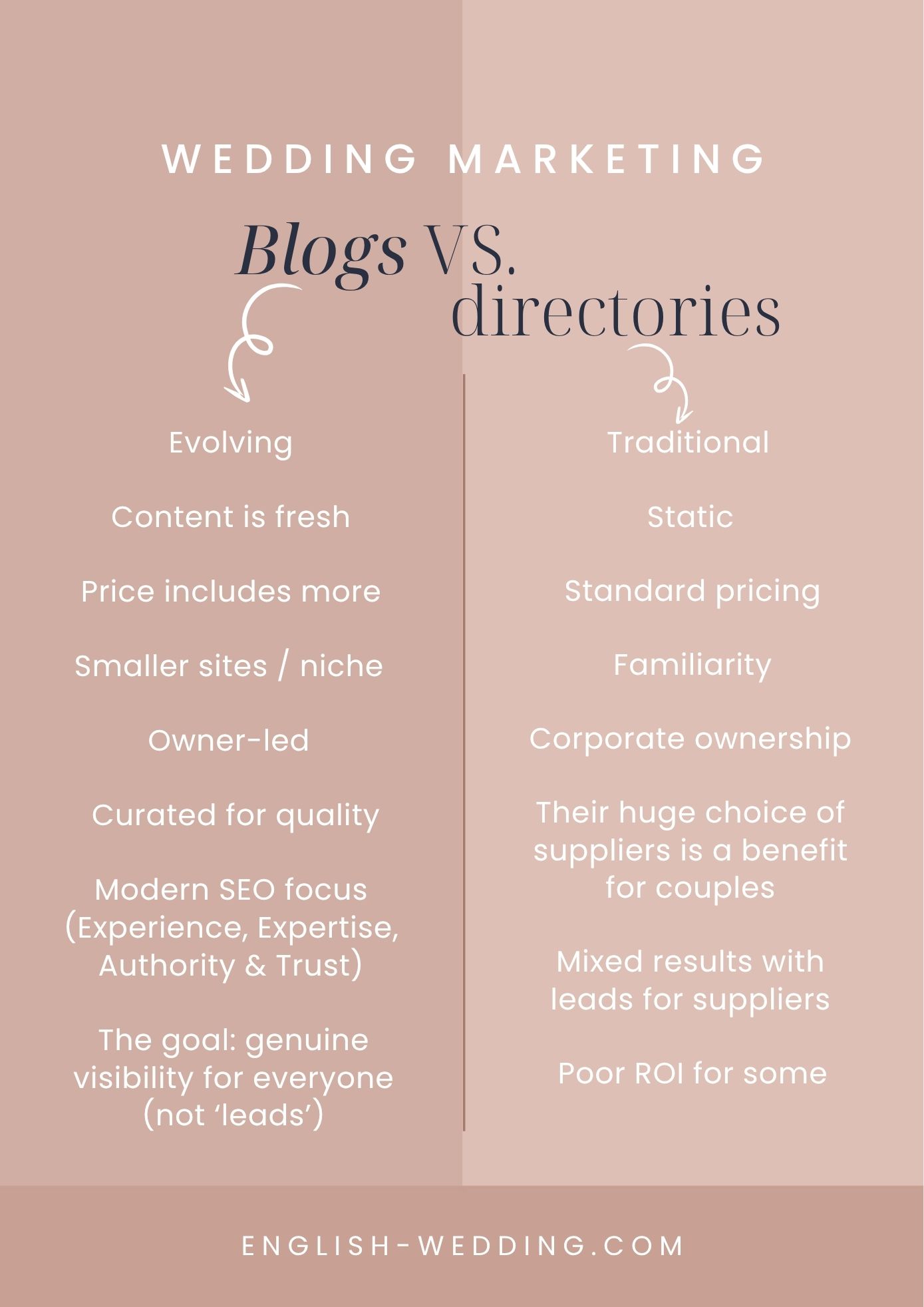
- Blogs are constantly evolving in line with SEO and AI search. Wedding blogs are independently owned and can be super flexible with their content.
- Content is fresh, because home page features and articles are the heart and soul of wedding blogs, over and above their built-in supplier lists
- The price you pay for a blog membership / partnership or advert includes more than just a ‘listing’. Blogs aren’t promising to generate ‘leads’ the way old school directories did. Instead, your regular features – if they’re optimised for modern search – will build recognition, credibility and goodwill towards your wedding business.
- Blogs are smaller and often more niche-focused than directories. For an individual wedding business owner, that’s a good thing. You’ll have a genuine relationship with the blogger, a higher chance of being featured, and there’ll be less ‘noise’ across the blog.
- The way wedding blogs are still owner-led with a friendly and approachable face at the helm – that means something. (Most) UK wedding blogs aren’t corporate-owned. It always feels good to know you’re reaching out to a person, not a department, right?
- Because they’re owned and written by individuals (much the same as most wedding photography or wedding planner businesses), wedding blogs are curated for quality. The reputation of their editor rests on the content they publish and the brands they recommend. As a result wedding blogs are honest, thoughtful and genuinely determined to help and support your wedding business. We also recognise your business is human-led; you run a wedding business you adore, because you have a home, a life and a family relying on you.
Same! Wedding bloggers get you. And we’ve got you. - Blogs have a modern SEO focus: our business model isn’t to ‘recruit suppliers on premium packages for money’. It’s to work alongside you, understand what you and your wedding business need, and help build your online reputation. To achieve that, we consider your Experience, Expertise, Authority and Trust, and publish your articles to build on those pillars. They’re important to Google and relevant across other search platforms too.
- A common misunderstanding about wedding blogs is that couples will book you directly from one piece of content. That’s not how blogs work – wedding blog platforms exist to support your wedding business, amplifying your voice, providing high value links back to your content, helping your brand appear higher in search rankings (now including AI search). All of this counts towards building a brand which inspires trust – and that’s how couples will feel confident reaching out to you when they’re ready to book.
Wedding blogs vs directories: comparison
| Feature | Wedding Blogs | Wedding Directories |
|---|---|---|
| Content | Fresh, editorial, regularly updated | Static listings |
| SEO value | Builds authority and long-term visibility | Limited to directory page ranking |
| Competition | Curated, fewer suppliers | High competition within categories |
| Relationship | Direct with blog owner/editor | Sales-led, platform-based |
| The appeal | Modern visibility | Tradition |
| The business model | More collaborative | Classic B2B: a clean transaction |
Blogging anywhere is a powerful tool – here’s why
- Writing blog posts is the simplest way to publish fresh content around your business
- Your brand’s personality can shine on a wedding blog: you can write in a friendly, knowledgeable and empathetic voice.
- Unlike social media or corporate-owned wedding websites, you have full control over your wedding blog content.
- The thoughtful content you publish on blogs has genuine longevity. Where social media dazzles and burns, and traditional directories snooze, articles you publish on wedding blogs have a lifespan of a couple of years, sometimes even more. They’re golden for wedding business SEO.
Guest blogging on wedding websites establishes reputation
Supporting what you say on your own website and blog builds your brand authority (how trustworthy and credible you are). Anyone can tell the world how amazing they are on their own domain. If other people and other websites are repeating that message and highlighting your voice, it adds value to your brand. So:
- Use guest blogging on blogs like English Wedding to share what you know, and the advice you give your couples in real life. Use your real, honest, human voice, same as you would in a natural conversation.
- Show proof of experience – refer to your past weddings and reviews, and quantify your years in business and how many events you’ve been trusted to work on.
- Be welcoming. Getting published on wedding blogs helps you to reach a new audience, of couples who might not discover you otherwise. Approachability is important.
Conclusion: wedding blogs vs directories
Wedding directories still exist because that’s the way things have always been: they’re a familiar marketing tool. But wedding blogs offer stronger long-term value for suppliers. Use them to publish your thoughtfully written content, improve your SEO and build credibility for your brand. Directories simply aren’t keeping up with modern online search – and while Hitched and Bridebook might be household names, their reputation just enables them to sell you their advertising space. If a more considered visibility strategy suits your wedding business brand, wedding blogs are the perfect place to share your meaningful content in 2026.



0 Comments